

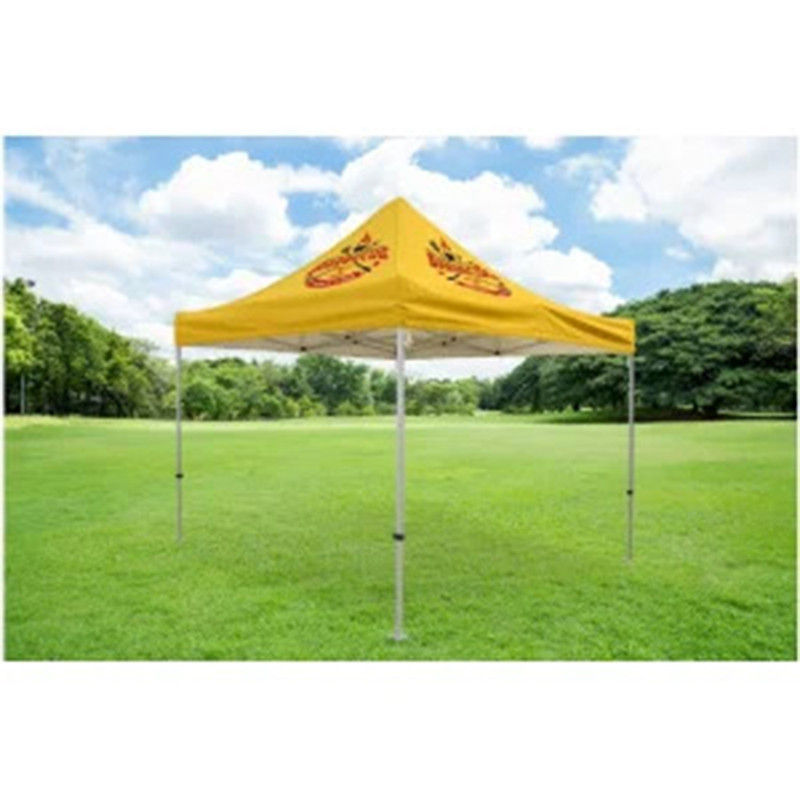
A branded marquee does two jobs at once. It shelters your team and your stock, and it advertises you from every angle a crowd can approach from. That second job is the one most briefs underestimate. A marquee at a market, a sporting sideline or a trade expo is often the tallest branded object in the space, visible from further away than any banner, and it works whether anyone is standing at your stand or not.
- A 3x3m marquee is the standard market and event footprint, with 3x4.5m and 3x6m available for larger stands.
- The roof valance is the most valuable branding surface because it sits at eye level from every approach.
- Full colour dye sublimation carries photographic artwork across the whole canopy; screen print suits bold single colour logos.
- Weights or pegs are not optional. An unsecured marquee is the single most common cause of damage at outdoor events.
Marquee sizes and what they suit
Marquee footprints are quoted in metres, and the size you choose is driven by the space you are given rather than by the crowd you expect. Market and event organisers usually allocate stands in three metre increments, which is why the 3x3m marquee is the default across Australia.
| Size | Footprint | Best for |
|---|---|---|
| 3x3m | One standard stand | Markets, sporting sidelines, community events, single stall setups |
| 3x4.5m | One and a half stands | Stands needing a serving counter plus storage behind |
| 3x6m | Two standard stands | Expo presence, team shelter, multi-station activations |
Two practical checks before you commit to a size. Confirm the stand dimensions with the organiser in writing, because a 3x3m marquee needs slightly more than three metres once the legs are splayed and guy ropes are out. And confirm who transports it, because a 3x6m marquee is a two person lift, not a one person job.
Which panels carry your branding
A marquee has more branded surfaces than most buyers realise, and they are not equally valuable.
- The valance, the vertical band that runs around the edge of the roof. This is the most valuable surface on the marquee, because it sits at eye level from every direction and stays visible when the stand is crowded.
- The roof panels, which read from a distance and in aerial or elevated photography. Useful for a large logo or a block of brand colour.
- Full or half walls, which turn the back and sides into signage and give you a clean backdrop for photographs.
- The leg covers, a smaller surface that suits a repeated logo or a web address.
Printing options for marquees
Marquee fabric takes the same decoration methods as an umbrella canopy, and the choice follows the artwork rather than preference.
Screen printing lays down bold, flat colour and suits a single or two colour logo on a coloured panel. It is the most economical route for simple marks at volume. Full colour dye sublimation prints the artwork into the fabric, so colour runs edge to edge with no join marks, and it carries gradients, photographs and complex artwork that screen printing cannot. If your brand relies on a photographic background, a gradient or more than three colours, sublimation is the method. Our printing methods guide compares the three approaches in more detail.
Colours are matched to your PMS references as closely as the fabric and print process allow, and a digital proof is prepared as part of the order process so you can see the layout on the marquee before production. For critical colour we can supply a fabric swatch for physical approval.
Frames, weight and wind
The frame decides how long the marquee lasts and how safely it behaves. Pop-up frames use a concertina structure that one or two people can raise in minutes without tools, which is what makes them practical for a team that sets up weekly. Heavier commercial frames use thicker sections and stronger joints, and they suit a marquee that lives outdoors or gets used every weekend.
Securing the marquee is not optional and it is not an accessory. Wind under a marquee roof generates lift, and an unsecured frame will move. On grass, use pegs and guy ropes. On concrete, asphalt or a footpath where you cannot peg, use weights on every leg. Most event organisers and councils require this, and many will ask to see it before they let you trade.
Ordering, artwork and lead time
Marquees are made to order with your artwork, so the process runs the same way as a printed umbrella. Supply vector artwork with fonts outlined, tell us the panels you want printed, and we prepare a digital proof as part of the order process. Production runs approximately 10 working days from artwork approval, with rush orders accommodated where possible and subject to stock availability.
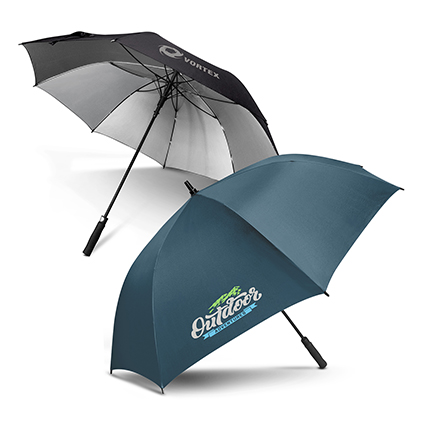
If the marquee is for a dated event, work backwards from the date and add delivery time on top. Tell us the event date first and we will tell you what is achievable. Many buyers order the marquee alongside market umbrellas so the whole outdoor setup reads as one brand, and the same artwork carries across both.
See the marquees and gazebos range for current sizes and frame options.
Common questions
What types of printing options are available for promotional marquees
Two methods cover almost every marquee order. Screen printing lays down bold, flat colour and suits single or two colour logos, and it is the most economical route at volume. Full colour dye sublimation prints artwork into the fabric so colour runs edge to edge, which carries photographs, gradients and complex multi-colour artwork. Colours are matched to your PMS references as closely as the fabric and process allow.
What size marquee do I need for a market stall
A 3x3m marquee is the standard market and event footprint in Australia, because organisers usually allocate stands in three metre increments. Choose 3x4.5m if you need a serving counter plus storage behind it, and 3x6m if you have two stands or need to shelter a team.
Which part of a marquee should carry the logo
The valance, the vertical band around the edge of the roof. It sits at eye level from every direction and stays visible when the stand is busy, which the roof panels do not. Roof panels are worth printing as a second surface for visibility at distance and in elevated photography.
Do printed marquees need weights or pegs
Yes. Wind under a marquee roof generates lift, so the frame must be secured on every leg. Use pegs and guy ropes on grass, and weights where you cannot peg into concrete or asphalt. Most event organisers and councils require it and many will check before allowing you to trade.
How long does a custom printed marquee take
Production runs approximately 10 working days from artwork approval, with rush orders accommodated where possible and subject to stock availability. Delivery time is on top of that and depends on your location, so tell us the event date first and we will work backwards from it.
Can a marquee match our branded umbrellas
Yes. The same artwork and PMS references carry across marquees, market umbrellas and handheld umbrellas, so an outdoor setup reads as one brand rather than three separate purchases.
Tell us the stand size, the event and the panels you want printed, and we will scope the marquee and quote it. Get expert advice or call 1300 25 60 70.